
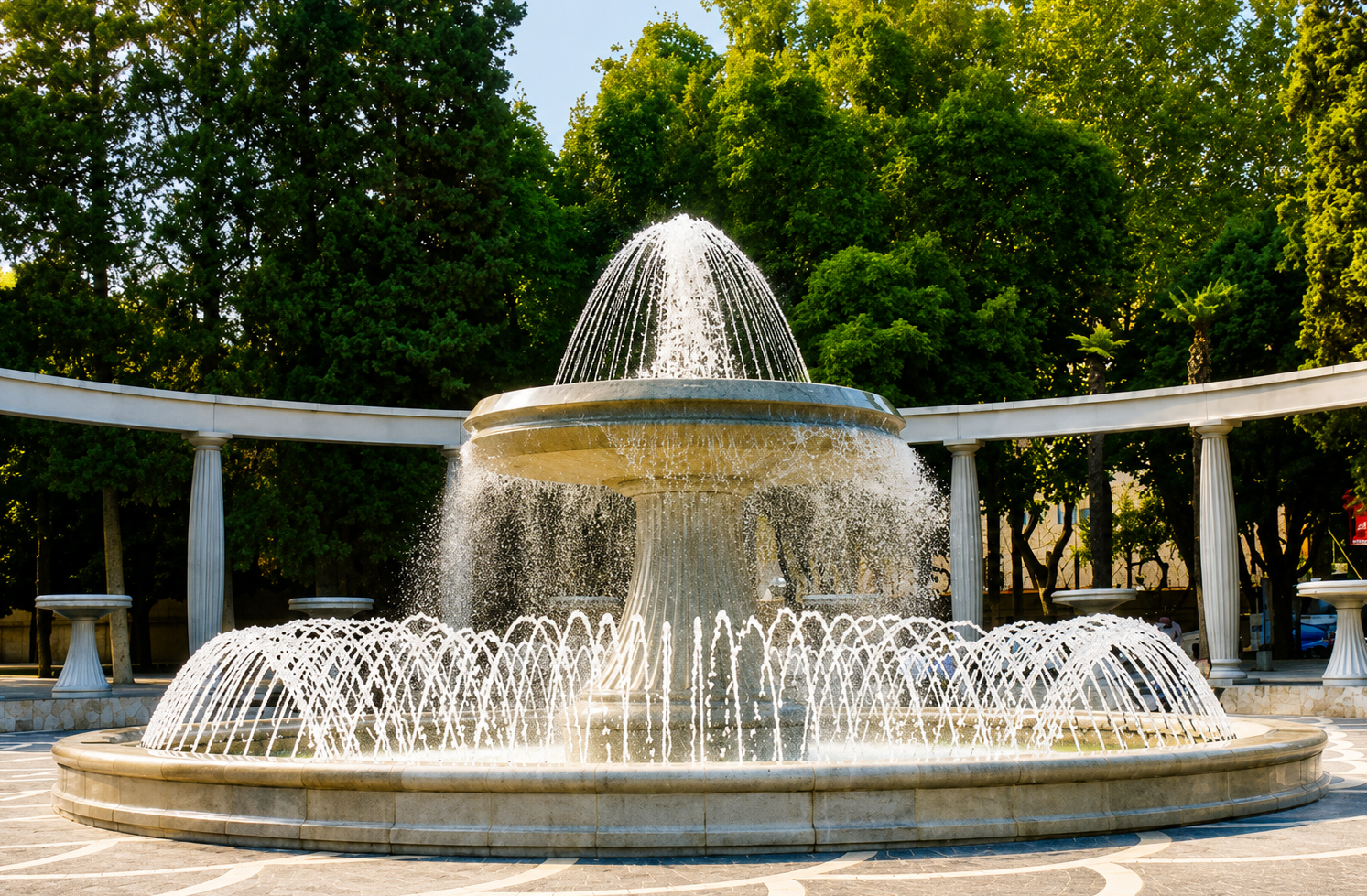
When travelers plan tours in Baku, one destination consistently tops every itinerary — the iconic Baku Fountain Square. Known locally as “Fəvvarələr meydanı,” this vibrant public square sits at the very heart of downtown Baku, the capital of Azerbaijan. It is more than just a pretty urban space — it is a living canvas of the city’s past, present, and future. From Soviet-era fountains to modern boutiques and buzzing café terraces, Baku Fountain Square is where history, culture, and everyday life beautifully converge. Whether you visit at sunrise or linger past midnight, this square never fails to captivate every visitor who sets foot on its elegant stone pavements.
The Origins: From ‘Parapet’ to Fountain Square Baku
Long before it earned its current name, the area that is now fountain square Baku was known simply as “Parapet” — a name still fondly used by longtime Baku residents today. The origins of this nickname trace back to the early 19th century, when Russian imperial forces took control of the South Caucasus and began reshaping Baku from a walled fortress city into a modern urban centre. In those early years, the area served as an open gathering space on the edge of the old city walls of Icheri Sheher, functioning as a kind of informal town square where merchants, soldiers, and local residents crossed paths daily.
As Baku grew in importance — especially after the first oil boom of the 1870s and 1880s — the city’s architecture and public spaces underwent dramatic transformation. Wealthy oil barons invested heavily in grand buildings, boulevards, and parks. The area around the Parapet began to take shape as a proper public square, lined with commercial establishments and elegant European-style architecture that still defines much of Baku’s cityscape today.
The Soviet Era: Fountains That Gave the Square Its Name
The most defining chapter in the history of Baku Fountain Square came during the Soviet period. After Azerbaijan was incorporated into the Soviet Union in 1920, Baku underwent yet another wave of urban development driven by central Soviet planning. It was during this era that dozens of decorative fountains were installed across the square, transforming what had been a simple open space into one of the most visually striking public areas in the entire Soviet South Caucasus.
These fountains — varying in size, design, and water display — gave the square its new, official identity. By the mid-20th century, it was no longer just “Parapet” but was formally recognized as Fountains Square. The water features became a beloved symbol of Baku’s civic pride and a natural gathering point for families, students, and workers enjoying their leisure time. Evenings at the square took on a festive atmosphere, with fountain lights illuminating the night and music drifting across the open air. This tradition of the square as Baku’s social heart took deep root during the Soviet decades and has never faded.
Post-Independence Renaissance: A Square Reborn
When Azerbaijan gained independence in 1991 following the dissolution of the Soviet Union, Baku Fountain Square entered a new and exciting phase of its history. The city, now the capital of a sovereign nation, began investing heavily in its public spaces and cultural infrastructure. Fountain Square Baku remained at the center of this vision — a symbol of national identity and urban renewal.
The most significant transformation came in 2010, when Baku city authorities undertook a comprehensive renovation of the square. The project modernized the fountains, resurfaced the walkways with high-quality stone, improved lighting infrastructure, and introduced new landscaping including the palm trees that now give parts of the square a surprisingly Mediterranean feel. The renovation struck a careful balance between preserving the historic character of the space and bringing it up to international standards as a world-class tourist destination.
After the 2010 renovation, Fountain Square Baku quickly gained recognition far beyond Azerbaijan’s borders. International travel publications, including National Geographic and Lonely Planet, began featuring it as one of the must-see spots in the region — drawing visitors from Europe, Asia, and the Middle East who come to experience Baku’s unique blend of East and West.
Architecture and Atmosphere: What Makes It Special
One of the most remarkable qualities of Baku Fountain Square is the architecture that frames it. Walking through the square, visitors are surrounded by stunning 19th and early 20th-century buildings that speak to the prosperity of Baku’s oil boom era. Ornate facades with Neo-classical and European influences line Nizami Street — also historically called Torgovaya Street — which runs parallel to the famous Baku Boulevard along the Caspian Sea coast.
The square itself stretches from Istiglaliyyat Street and the walls of Icheri Sheher (the UNESCO-listed Old City) through Nizami Street. This geography means that a single stroll through fountain square baku takes you from the ancient walled city on one end to a lively modern shopping and dining district on the other — a remarkable compression of centuries of history into a single walkable space.
Dozens of working fountains — large and small, classical and contemporary — animate the square at every turn. At night, coloured lighting transforms the water displays into glittering spectacles, making evening visits particularly magical. The blend of historic stone buildings, swaying palms, water features, and ambient light creates an atmosphere unlike anywhere else in the Caucasus.
A Hub of Culture, Events, and Celebration
Baku Fountain Square has always been more than a scenic backdrop — it is a living stage for the city’s cultural life. The square serves as the venue for numerous public festivals, concerts, national celebrations, and civic events throughout the year. On Novruz (Azerbaijani New Year in spring), the square fills with traditional music, dancing, and fire displays. National holidays draw enormous crowds who gather here to mark Azerbaijan’s proudest moments together.
Since 2013, one of the most enchanting annual events has been the Fountains Square Christmas Market, held from December through January. Modelled on European yuletide markets, the event features handicraft stalls, seasonal food and drinks, live entertainment, and a festive atmosphere that draws both locals and tourists in large numbers. This annual charity-driven market has become one of Baku’s most photographed and beloved winter traditions, reinforcing the square’s role as the emotional centre of the city.
Beyond seasonal events, the square is a daily gathering point. After business hours and on weekends, it fills with families, young couples, street performers, and tourists. Boutiques, restaurants, cafes, and a covered passage filled with antique merchants give it a lively commercial energy that complements its historical gravitas.
Hotels Near Fountain Square Baku: Where to Stay
For tourists who want to experience Baku’s historic centre to the fullest, staying close to the square is an excellent choice. There are several outstanding hotels near fountain square baku that put you within walking distance of not only the square itself but also the Old City, the Baku Boulevard, and the city’s finest dining and shopping.
The Four Seasons Hotel Baku, located just minutes away on the Caspian waterfront, is widely regarded as one of the finest luxury stays in the region, offering stunning sea views and impeccable service. The Fairmont Baku at the Flame Towers is another flagship property — perched above the city in the iconic triple-flame skyscrapers — with panoramic views over the entire city including Fountain Square below.
For visitors seeking a more boutique experience, the JW Marriott Absheron Baku and several charming smaller hotels along Nizami Street and Istiglaliyyat Street offer convenient, comfortable bases from which to explore on foot. Staying in this neighbourhood means you can wander down to Fountain Square at any hour — whether for a morning coffee, a midday stroll, or a late-night fountain-lit walk — and soak in the atmosphere at your own pace. For budget-conscious travellers, a range of well-reviewed guesthouses and mid-range hotels in the surrounding Sabail district also offer easy access to the square.
Conclusion: A Square That Tells Baku’s Story
Few places in the world compress so much history, beauty, and living culture into such an accessible and walkable space as Baku Fountain Square. From its humble origins as a dusty “Parapet” on the edge of a medieval fortress city, through Soviet reinvention and post-independence renaissance, to its current status as one of the Caucasus’s most celebrated public destinations — the square’s story is really Baku’s story.
Every fountain, every 19th-century facade, every evening market stall, and every laughing family gathered around a water display is a chapter in that ongoing narrative. For any traveller arriving in Azerbaijan, a visit to Baku Fountain Square is not just recommended — it is essential. It is the place where you will understand, perhaps better than anywhere else in the city, exactly what makes Baku so endlessly fascinating.
Frequently Asked Questions
Baku Fountain Square is located in the heart of downtown Baku, in the Sabail district — the historic central part of the city. It sits between Istiglaliyyat Street and Nizami Street, right alongside the walls of the Old City (Icheri Sheher). This central location makes it extremely easy to reach from virtually any part of Baku, and it serves as a natural starting point for exploring the city’s most iconic landmarks.
Baku Fountain Square is located in Baku itself, the capital and largest city of Azerbaijan. However, if you are travelling from nearby cities, Sumqayit (roughly 30 km north of Baku) is the closest major urban centre. Tourists often base themselves in Baku and visit Fountain Square as part of their city exploration, making it a convenient hub for day trips across the Absheron Peninsula.
Absolutely — Baku Fountain Square and the surrounding area are highly walkable. The square itself is a pedestrian-only zone, and it connects seamlessly on foot to the Old City walls, Nizami Street (Baku’s premier shopping boulevard), and the famous Baku Boulevard along the Caspian Sea. Most of the city’s top attractions, restaurants, and hotels are within a comfortable 10–15 minute walk from the square, making it ideal for tourists who prefer to explore on foot.
Baku Fountain Square is beautiful year-round, but the best times to visit are spring (April–June) and early autumn (September–October), when the weather is pleasantly warm and the square is at its most vibrant. Evenings are particularly magical — the fountains are lit up with colourful lights, and the cafés and restaurants are buzzing. If you visit in December or January, you can enjoy the annual Fountains Square Christmas Market, one of Baku’s most beloved seasonal events.
Yes, Baku Fountain Square is completely free to enter and explore. As a public square in the city centre, it is open to everyone at all hours of the day and night. While the boutiques, restaurants, and cafés around the square have their own prices, simply strolling through, admiring the fountains, and soaking in the atmosphere costs nothing at all — making it one of the best value experiences in all of Baku.
There is plenty to enjoy at Fountain Square Baku. Tourists can stroll along the elegant stone walkways, relax by the fountains, and admire the historic 19th-century architecture. The square is lined with boutique shops, cafés, and restaurants perfect for a meal or a coffee break. It is also close to Icheri Sheher (the Old City), Nizami Street for shopping, and the Baku Boulevard waterfront. Throughout the year, the square hosts festivals, concerts, and seasonal markets — there is almost always something happening.

Comment (0)